




There are moments when you walk into a space and immediately know you’re in the right place.
That’s what happened to me at RSVP London, an exclusive gathering of luxury event professionals that brings together the world’s finest creators to discuss design, experience, and philosophy. It’s not a traditional conference. It’s a community where you discover you’re not alone in the questions you ask, the principles you defend, and the way you understand your work.
I spent three days in London — April 10-12 — navigating experiences that were themselves lessons in intentional design. Every detail of RSVP was thoughtfully crafted to communicate something. And that’s exactly what brought me back to my work with renewed clarity.
Day one: when color stops being decoration
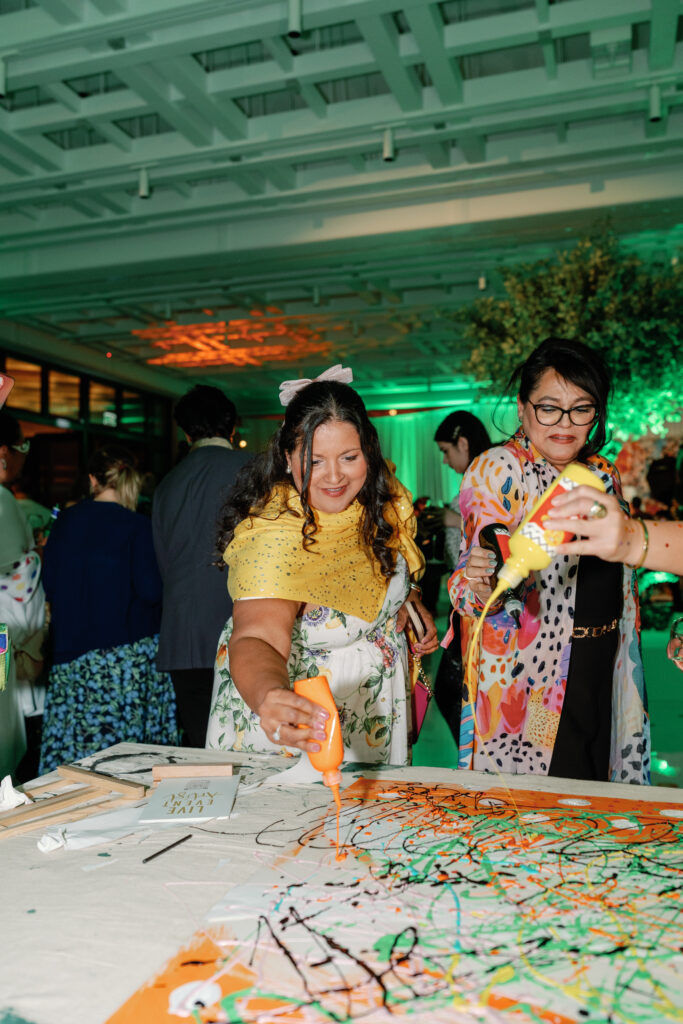
RSVP began with a simple invitation: “A Load of Pollocks” — a reference to Jackson Pollock and the idea that expression matters more than perfection.
The evening took place at Park Hyatt London, overlooking the Thames. But what struck me wasn’t the view. It was the intention behind every visual choice.
The room was white. Completely white. And then, against that intentional emptiness, color exploded. Not random colors, but color as emotion. Color as language. An artist painted live as we talked. Colorful stickers could be placed on the floor. There was a moment where all 200 of us professionals were invited to paint together a white canvas that would become the collective memory of the night.
This made me think about how I work with color in weddings. Usually, people think of color as decoration — “what color flowers,” “what color linens.” But what I saw in London was different. Color was intention. It was emotion made visible. It was a system of communication

Day two: design as narrative
The second evening was about tables. Specifically, about how a table can tell a story. The theme was “Come as your favourite work of art,” where each person was to interpret an artwork through their outfit. I saw people arriving as Frida Kahlo, as Hockney works, as abstract sculptures. It was chaotic and perfect. But when asked what my favorite artist was, my answer was different. I don’t have a painting I love. I don’t have an artist I love, a poem I love in the traditional sense. But I have Jesus.
So I chose to represent a disciple of Jesus. Not as an obvious religious figure, but as a personal narrative about creativity, faith, and origin. My look was built with intention in every detail:
- The foundation: Off-white linen pants and blouse. Everything minimalist, everything simple. Because in that era — the era of the disciples — there was no sophistication. There was only presence and purpose.
- The feet: Sandals reminiscent of those worn in antiquity, with designs of Christian symbolism. The fish is one of the oldest symbols of Christianity, and I wanted to bring that element subtly.
- The accessories: A fish-shaped earring. A fish-shaped bracelet. A simple gold chain with a tiny cross, because I wanted something very minimalist, very discreet. Nothing too sophisticated. Nothing that shouted.
- The hair: A side braid. Simple. Unpretentious.
- The larger accessories: A Jerusalem bag my mother gave me, carrying personal meaning. And my children’s Bible, which I carried as an accessory, as if it were the continuation of this story.
- The context: A fascinator — that accessory worn in London — in the same color as my outfit, to contextualize the location while maintaining visual coherence.

When people asked me why Jesus, I explained: I didn’t have anything I loved in the traditional sense of art. But when I think of poetry, I think of Psalms. When I think of creativity, I think of who created everything. And when I think of who represents me, I think of Jesus.
Because God is the author of all creativity. No one is more creative than Him. He is the creator of everything. He made the world. He gave us the talents we have today to create anything. So there was no art, no poetry, no singer that surpassed this for me. I am a disciple of Jesus. And He is my favorite. He is the artist of artists. He is the creator of creators. And that, for me, was the only authentic representation I could make.
When I arrived and saw the other people in their looks — some elaborate, some subtle — I realized that RSVP wasn’t asking you to be someone you’re not. It was asking you to choose consciously. To communicate something about yourself through a single visual choice.
My look was minimalist, but it wasn’t empty. It was a statement. It was about understanding that luxury is no longer about the quantity of elements. It’s about intention in every choice. It’s about bringing elements that tell a story that is truly yours.

And then, the table design exhibition. Each table was a different narrative. They weren’t beautiful tables — they were tables that spoke. One told the story of a wedding in Marrakech through colors, textures, and objects. Another was so minimalist it was almost empty, yet in that emptiness was an entire philosophy about space and breath.
This immediately connected me with a concept I’ve always believed in: a wedding is not a collection of beautiful elements. It’s a coherent visual narrative. When I work with a couple, I never start by asking “what color do you like?” I ask “what story do you want to tell?” Because once you have the story, everything else — the color, the texture, the arrangement of tables, the food — everything aligns naturally.
At RSVP, I saw designers from around the world applying exactly this principle. And it was validating. It’s not an alternative approach. It’s the path the best are following.
Day three: the conversation that matters
The third day was divided into two parts. In the morning, the business symposium. In the evening, the RSVP Awards and the launch of “The Art of Design – The Floral Poet” by Tomas de Bruyne. But it was the morning that moved me most deeply. Three speakers shared their philosophies:
One spoke about how a destination isn’t chosen because it’s beautiful, but because it means something. One speaker works with destination weddings in Istanbul, and the point was clear: location determines the operational structure, the possibilities, and — most importantly — the narrative of the wedding. Istanbul isn’t chosen for its beauty. It’s chosen because that couple has a story with that place.
That’s exactly what I do with Italy. I don’t sell Italy as a beautiful destination. I help couples understand if Italy belongs to their story. If there’s resonance between who they are and what Italy represents.

Another speaker presented what he calls “The Three Pillars”:
- Relevance — Something that only works for that specific couple. He gave examples: a couple who met in southern France got married there. Another couple who loves water got married in the Maldives with a glass aisle over a pool with floating roses. Relevance isn’t sentimental. It’s strategic.
- Timelessness — It’s not about trends. It’s about class. About design that lasts, about simplicity beating novelty, tradition beating fashion.
- Originality — It doesn’t mean more noise. It means being unmistakable.
When I heard this, I thought of every wedding I design. I always seek these three pillars, even if I don’t name them as such. Relevance, by understanding why this couple, why this place. Timelessness, by thinking of design that will last, that the couple will love in 10 years. Originality, seeking something that’s unmistakably theirs.
Finally, there was a discussion about memory and detail. And that was transformative. Something was said that I’ll carry forever: “We’re not selling events. We’re selling the feeling we remember.”
And then the difference was explained between short-term cognitive memory (you remember there were 150 people, the food was good) and “forever memories” — episodic memory (you remember the worn shoe at the foot of the bed, the magazine with folded pages, the four shades of lipstick tested). Details are what create memory. Not the big picture. It’s the details that whisper the story.
An example was given that frightened me a little: an event called “Rumble in the Jungle” was 99.9% perfect. But there were plastic fruits at the stands. One small thing. And it destroyed the entire immersion. That made me think about how many times a couple doesn’t notice a detail I spent hours thinking about. A candle that’s there because that specific color matters. A flower that was chosen because it represents something. An invisible detail that creates the feeling that “everything is right.”
I left London with renewed clarity about why I do what I do. I’m not selling beautiful weddings. I’m creating the conditions for a couple to be completely present in their own wedding. I’m protecting the space where real memory can happen. Every choice I make — every color, every detail, every rhythm of the night — is a choice about what memory I want to remain.
When I work with a couple, I’m answering questions that go beyond “what’s your style?” I’m answering: “What story do you want to tell? What matters to you? What memory do you want your guests to take home?” And then, with clarity about those answers, every detail aligns. Color isn’t decoration. It’s intention. The table isn’t beautiful. It’s narrative. The rhythm of the night isn’t an agenda. It’s breath.

RSVP validated something I already believed, but now I see it more clearly: excellence isn’t a destination. It’s a practice. It’s staying constantly connected to the global conversation about design, experience, and philosophy. It’s evolving. It’s questioning. It’s learning. Every couple I work with deserves to be with someone who’s in that conversation. Who’s in London listening to the world’s best designers and bringing those learnings back to their work.
Day three evening: when the extraordinary becomes possible
The final evening was surreal. Literally. The theme was “Dripping Dalí-ism” — surreal, dreamlike, unapologetic. The venue was The Chancery Rosewood. And the atmosphere was one of genuine celebration. It wasn’t about selling anything. It was about recognizing visionaries. About celebrating a community doing real work.
I saw designers I admire, that I’ve studied, that inspired my work. And I realized I’m not so far away. That the principles I defend are at the center of the global conversation. That night, as Tomas de Bruyne’s book was launched — a book about floral design as poetry — I understood that’s what I do too. I’m not planning weddings. I’m creating poetry. I’m creating moments where reality softens and the extraordinary becomes possible.

When I returned to Italy, everything felt different. Not because it changed. But because I changed. Now, when I talk with a couple, I have words for what I always knew. Relevance. Timelessness. Originality. Memory. Intention. Clarity. And when I design a wedding, every choice is more conscious. Because I know I’m not creating an event. I’m creating a memory. I’m creating the conditions for a couple to be completely present. I’m protecting the space where the soul of the wedding can breathe.
RSVP reminded me why I love this work. It’s not about beautiful flowers or photogenic locations. It’s about creating experiences that matter. It’s about staying connected to the global conversation about design and experience. It’s about constantly evolving. And it’s about understanding that every couple deserves to be with someone who’s in that conversation. Who’s questioning. Who’s learning. Who’s evolving.