



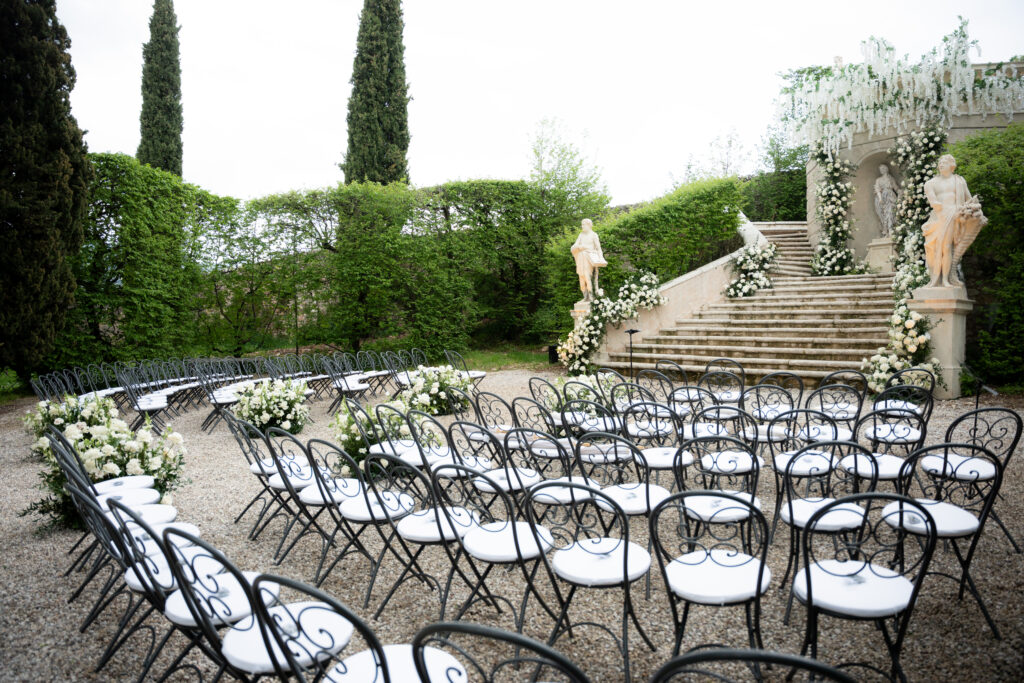
The single day wedding is no longer the default. One in five couples now stretches the celebration across three days or more, creating what the industry calls a wedding week, a sequence that opens with a welcome dinner, moves through the ceremony, continues the next day and sometimes closes with a farewell brunch. The data comes from recent industry research, including a 2024 study by Marry Me in Tuscany and a 2026 report from WeddingsItaly in partnership with Castello Petrata, and it confirms something anyone working on weddings in Italy has noticed for a while. The celebration no longer fits into twenty four hours.
A Week Instead of a Day
Thinking of a wedding as a week changes the question asked at the start of planning. It is less about organizing a party and more about designing a sequence of moments that speak to one another, each with its own rhythm and its own purpose. The welcome dinner introduces the families before the ceremony happens. The day after slows down what the day before concentrated. The farewell brunch closes the cycle without rushing. When these moments are treated as a single narrative, the wedding stops being one isolated event and becomes an experience guests walk through alongside the couple.

What the Extended Timeline Reveals

The logic behind the wedding week is simple. Less rush on the wedding day, more time for people to get to know each other beforehand. It is the concept of slow luxury applied to celebration, the same principle that has already reshaped how people think about travel, hospitality and food over the past few years, now arriving at weddings. Luxury here is not measured in the number of events, it is measured in the quality of presence within each one. A couple hosting guests over three or four days has time for conversations a single wedding dinner could never allow.
Why This Sequence Calls for a Wedding Celebrant in Italy
Spreading the celebration across several days also multiplies the complexity of organizing it. Each moment has its own location, its own vendor, its own flow of guests arriving and leaving at different times. This is where the work of a wedding celebrant in Italy becomes decisive, not simply as someone coordinating a schedule, but as someone who understands the emotional logic of each day and makes sure one moment sets up the next. Guest experience design, a recurring theme for anyone planning a destination wedding in Italy, matters even more here, because a guest who spends a week at the destination experiences the wedding differently than one who passes through it in a single evening.

In Italy, the Week Finds Its Own Territory

Italy has a natural advantage for this format. The geography of the country’s most sought after destination wedding locations, from vineyards to historic villages to properties built to host guests for days at a time, was shaped for extended time, not quick visits. A couple choosing Tuscany or the Amalfi Coast for a wedding week is not simply renting a space for a party. For a few days, they are borrowing the rhythm of a place that has always welcomed people this way, with time, with hospitality built to last longer than one night.
The wedding week is unlikely to fade quickly, because it answers something couples feel before they can name it, the wish for a wedding to be lived, not just watched. Shaping that experience with care, day after day, is the kind of work that comes from inside a place’s culture, not from outside it.